Client churn at agencies rarely happens because the work is bad. It happens because the client does not see the work. They do not know what you are doing month to month, they cannot tell if it is working, and eventually they start wondering what they are paying for. By the time they bring that question to a conversation, the decision to leave has usually already been made.
Reporting is the most underestimated retention lever an agency has. A client who receives consistent, clear reports is a client who feels informed. A client who feels informed is a client who stays. This is a pattern we see repeatedly across agencies that take reporting seriously: better reporting correlates directly with longer client relationships and fewer uncomfortable renewal conversations.
This post walks through the reporting changes that reduce churn, why they work, and how to implement them without adding significant overhead to your team.
Why Clients Actually Leave Agencies
Exit surveys from agency clients consistently point to a handful of reasons for leaving. Poor results are on the list, but not always at the top. More common: feeling uninformed, not understanding what the agency was doing, or not seeing the connection between the work and the outcomes.
These are all information problems, not performance problems. A client who understands what is happening and why is far more tolerant of slow months, algorithm changes, and the natural variability of digital marketing than a client who only hears from you when there is a pitch or an invoice. The agency that communicates well survives the slow months. The agency that goes quiet does not.
The other major churn driver is inconsistency. Reports that arrive sporadically, in different formats, with different metrics each month, signal that the agency does not have a process. Even if the work is excellent, inconsistent communication creates doubt.
The Reporting Changes That Made the Difference
Agencies that successfully reduce churn through better reporting typically make a small number of high-leverage changes rather than overhauling everything at once. Here is what actually moves the needle.
Fixed delivery dates, every month
Reports that go out on the first of every month, or every Monday, or on a specific date the client agreed to, become expected. Clients plan around them. They look for the report. When the report arrives, it reinforces that the agency is operating on a consistent schedule.
When reports arrive irregularly, or only when the client asks, it has the opposite effect. Clients start to feel like they have to chase information. That dynamic damages the relationship faster than almost anything else.
Consistent format and metrics
A report that looks the same every month is a report clients can learn to read quickly. They know where to look for sessions. They know where to find organic clicks. They develop a mental model of their own performance because the report gives them a stable reference frame.
Changing the format frequently, or including different metrics each month based on whatever was interesting that period, resets that learning curve every time. Keep the core structure consistent and add commentary around what changed and why. Switching to a live report link instead of a PDF removes the format problem entirely. Clients always see current data, not a frozen export from weeks ago.
Documented KPI goals with progress tracking
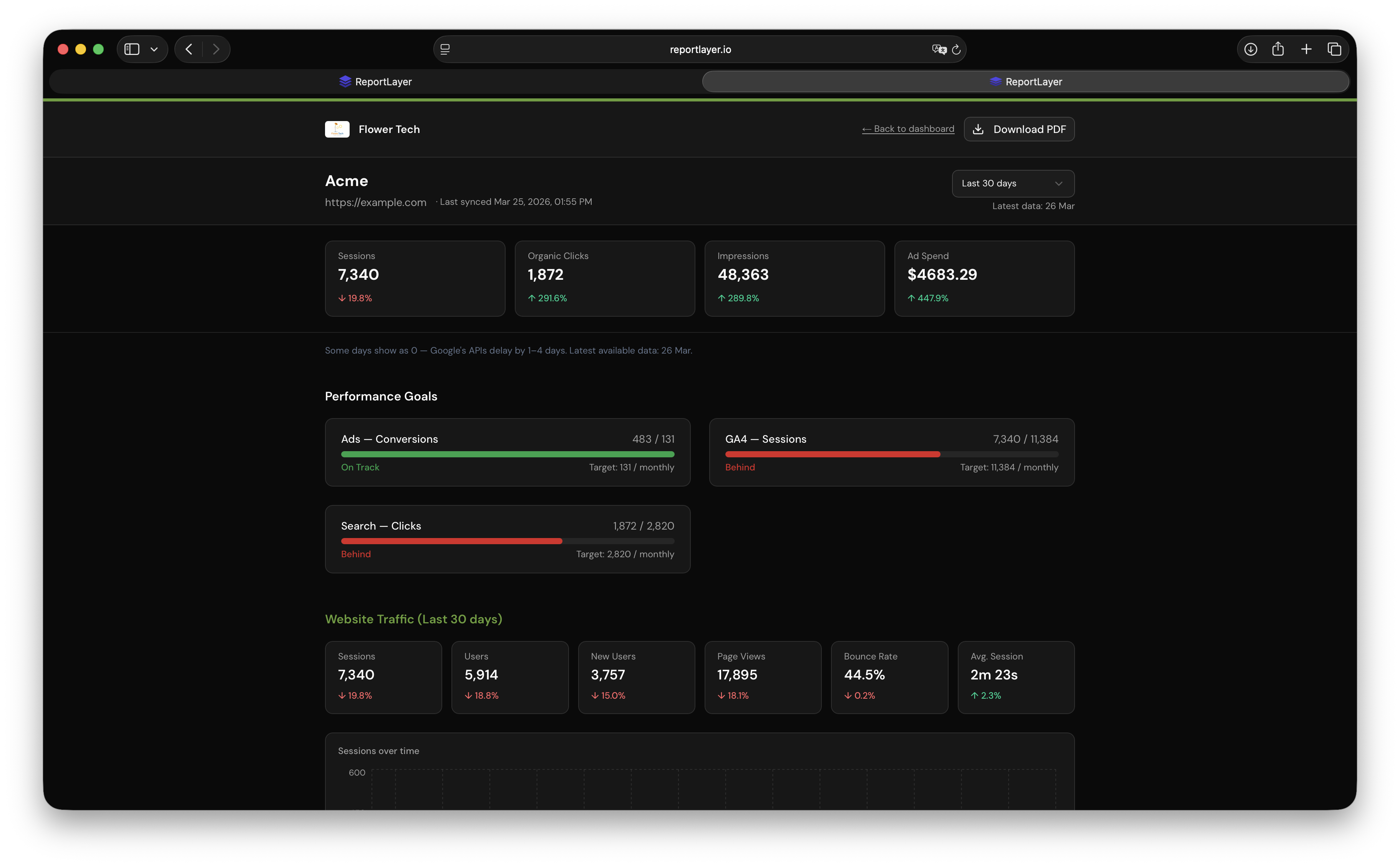
The most effective change most agencies can make is adding documented goals to their reporting. Instead of showing a client that they had 8,200 sessions this month, show them that they hit 82 percent of their 10,000-session goal. Suddenly the number has meaning.
Goals create shared accountability. The agency is on the hook for moving the metrics that matter to the client. The client is on the hook for approving budgets, content calendars, or other inputs the agency needs to do the work. Both sides have skin in the outcome, and the monthly report becomes a joint review rather than a one-directional delivery.
One-paragraph context on what happened
Numbers without explanation leave clients to draw their own conclusions. Those conclusions are often wrong, often pessimistic, and occasionally lead to emails asking if something is wrong. Adding a short narrative to each report: what changed this month, what caused it, and what is planned for next month, prevents most of those conversations before they start.
This does not need to be long. Three to five sentences covering the month's highlights, any notable changes in the data, and the focus for the upcoming period is enough. Clients read summaries. Make the summary useful.
The Impact on Retention
Agencies that move from ad-hoc reporting to consistent, structured, branded monthly reports typically see measurable retention improvements within two to three months. The exact numbers vary by agency size, client mix, and how bad the previous reporting process was. But the direction is consistent: fewer early terminations, longer average client lifetimes, and fewer heated conversations around renewal time.
There is a secondary effect worth noting. Agencies with strong reporting processes get more referrals. Clients who feel well-served talk about it. A branded, professional-looking monthly report is something clients sometimes share with peers when recommending the agency. It becomes part of the word-of-mouth case for working with you.
The inverse is also true. Clients who feel poorly informed talk about that too, and they are less likely to refer even if the actual results were good.
What the Transition Looks Like in Practice
Consider a mid-sized digital agency managing 18 clients across SEO, paid search, and content. Before improving their reporting process, reports went out whenever the account manager had time to compile them, usually late in the month or early the following month. The format changed depending on who assembled it. Some clients received PDFs, others received slide decks, a few received email summaries. There were no documented goals, so every report was a collection of numbers without context.
The agency moved to a consistent automated reporting setup: the same format for every client, delivered on the 1st of each month, with agency branding, documented KPI goals, and a short commentary section. Reports went out automatically. The account managers stopped spending 3 to 4 hours per client per month on assembly and started spending that time on commentary and strategy.
In the six months after the change, the pattern shifted noticeably. The volume of incoming questions about reporting dropped. Clients who previously sent monthly check-in emails asking for updates went quiet because the report answered their questions before they had to ask. Renewal conversations became shorter and less contentious because clients had 12 months of documented progress in front of them.
Reporting Mistakes That Accelerate Churn
Some reporting practices actively damage client relationships. These are worth identifying and eliminating specifically.
- Skipping reports during bad months: This is the fastest way to lose a client. When numbers are down, the instinct is to delay the report or send it with minimal commentary. That signals that you are hiding something. Send the report on schedule, explain what happened, and tell the client what you are doing about it.
- Reports that require a call to interpret: If a client cannot understand their report without scheduling a meeting, the report is not doing its job. It should be self-explanatory.
- Showing too much data without prioritizing:A 20-page report full of charts signals effort but does not communicate anything clearly. Focus on the metrics that matter to the client's specific goals and cut the rest.
- No branding:Reports that look like exports from a tool, or generic templates, do not reinforce your agency's value. A branded report that looks professional tells the client they hired a professional operation. See our guide to white-label client reporting for specifics on how to set this up.
- Inconsistent metrics month over month: Changing which numbers you report makes it impossible for clients to track trends. Pick a core set and stick to it.
Starting the Transition
The most effective approach is to standardize one client's reporting first. Build the template, document the goals, configure the delivery schedule. Once that client's reporting is running smoothly, roll the same setup to the next client. Within a few weeks, most agencies can have all clients on a consistent reporting schedule.
Tools like ReportLayer make this faster by automating the data pull from GA4, Search Console, and Ads, applying your agency branding across all clients, and handling delivery automatically. You configure each client once and the reports run themselves. The time saved on assembly goes back into the commentary and strategy work that actually requires a human.
View a demo reportto see what a consistent, branded monthly report looks like from the client's perspective.
Frequently Asked Questions
How much does better reporting actually reduce churn?
It varies significantly by agency and client mix. But the correlation between consistent, clear reporting and client retention is strong enough that most agencies see a meaningful change within two to three billing cycles of improving their process. The bigger the gap between previous reporting quality and the new standard, the more pronounced the effect.
Should I send reports monthly or weekly?
Monthly is the right default for most clients. Weekly reports work for clients running active paid campaigns where the spend is high enough to warrant that frequency. For organic and content-focused work, monthly is more appropriate: the signals are slower-moving and a weekly cadence creates noise without adding insight.
What should the reporting conversation look like during onboarding?
During onboarding, agree on three things: which metrics matter most to this client, what the target for each metric is, and when reports will be delivered. Document this and reference it in every report. Starting with documented goals means every report from the first one is a comparison against an agreed baseline, not a number without context.
How do I handle a client who never reads the report?
Send it anyway. A client who does not read monthly reports will read them when something goes wrong or when they are deciding whether to renew. Having 12 months of consistent, professional documentation of your work is valuable even if the client ignores it until that moment. The report is also protection for the agency: it documents what was done and what the results were.
Can better reporting justify a rate increase?
Yes. When you move from ad-hoc reporting to consistent, branded, goal-tracked monthly reports, you are demonstrably adding a service that had value before but was not being delivered reliably. Agencies often use a reporting upgrade as the context for a modest rate increase, framing it as a process improvement that the client directly benefits from. Most clients accept this when the improvement is real.
FREE GUIDE
5 Reporting Mistakes That Are Costing Your Agency Clients
The reporting errors that drive client churn, and how to fix them before your next monthly report.